


Crowdsourcing describes the outsourcing of activities to a large network of people based on a flexible, open invitation to participate (Blohm, Riedl, Füller, & Leimeister, 2016; Howe, 2006; Leimeister, 2015). Similar to traditional outsourcing, this approach aims to transfer tasks to outside suppliers and seeks to access external knowledge. In the BeeUp context, crowdsourcing is applied in order to generate a large number of new ideas for business model innovations, based on the inputs of an online pool of diverse and talented individuals. This pool of external knowledge and creativity represents one of the major advantages of crowdsourcing. BeeUp allows businesses to make use of these resources and enables them to develop their business model.
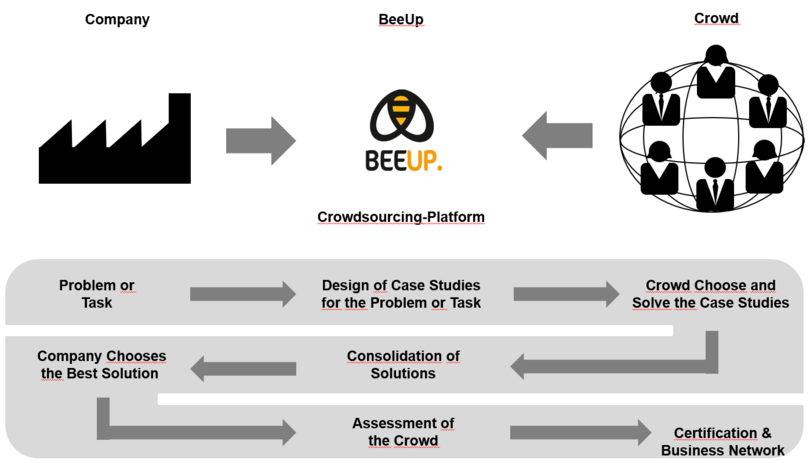
Fig.1: Crowdsourcing in the BeeUp Context, Source: Adapted from Leimeister (2012)
The above image illustrates the process typically employed in crowdsourcing. First, the company identifies the core competencies and challenges relevant to its business model in cooperation with BeeUp. Afterwards, these challenges are converted into an anonymized case study format that will be used in the BeeUp context. BeeUp forwards these case studies to the crowd and consolidates the incoming solutions. Following this, the company may select the solution that best addresses their previously defined challenges. Finally, the users are awarded with a certificate for their effort.
Crowdsourcing is beneficial for all parties involved. Users improve their business skills by solving real world case studies in practice. Companies, on the other hand, are provided with a wide variety of innovative ideas and solutions that are generated by a large network of talented people.
With this process, crowdsourcing in the BeeUp context allows businesses…
• … to use external knowledge and creativity to develop their business models.
• … to access a talented workforce on demand without incurring overhead costs.
• … to broaden their perspective and impede organizational rigidity or blindness.
• … to choose from a large number of different solutions for their problems.
• … to shorten problem-solving and decision-making processes.


