


 |
  |
SUMMARY OF THE ARTICLE
This case study looks at SEK, a more than 100-year-old corporation with traditional leadership structures. SEK is organised hierarchically, which initially made sense in a stable environment. The liberalisation of the energy sector triggered a strategy and earnings crisis at SEK. The timely identification of the upcoming troubles was due to luck. SEK was built to run in a stable environment. It didn't possess systematic foresight.
As soon as the need for action was recognised, SEK developed agile approaches. Much went well in the transformation. But a lack of 'refreezing' of the structure allowed a boomerang effect to occur, undoing the successes achieved. The case study describes what lessons can be learned from this for the leadership of agile organisations during a transformation.
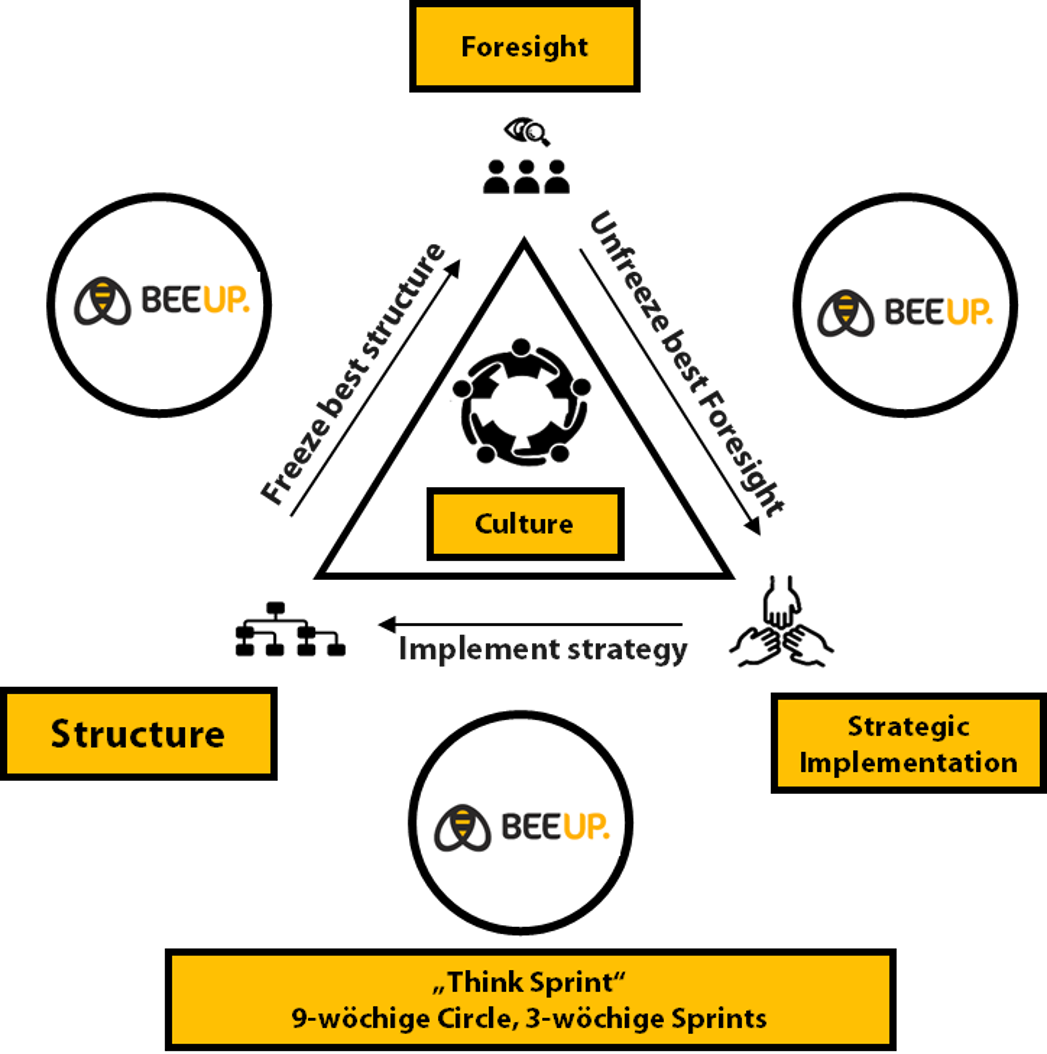
These observations served as the basis for the BeeUp FSSC model. It describes corporate development in agile organisations based on foresight, strategy, structure and culture. The case study shows that "new leadership" must change these three ordering models (see the terms in the St.Gall Management Model) synchronously for leading an organisation successfully. Neglecting the synchronous approach will most likely lead to failure in the development of the organisation.
There are temptations to neglect these classical ordering moments in the transformation from old leadership to new leadership.
|
The case study sheds light on the so-called "boomerang effect", which endangers or destroys success if neglecting the order moments. The boomerang effect, known in social psychology, states that "attempts at persuasion" lead to "unintended consequences" such as taking, defending opposing positions as well as fundamental opposition. When applied to business management, the boomerang effect means that efforts towards an agile organisation end in the increased hierarchy.
What has this case taught us?
Learnings around Strategic Foresight
L1: "Search and create facts to find the big elephant in the room."
L2: "The invisible part of knowledge about opportunities and threats must be made visible to all employees with a comprehensible process."
L3: "The whole organisation thinks along. It thinks and acts in scenarios."
L4: "The organisation develops systems and educates staff so that the workforce is part of an organisation's sensoring and foresight intelligence."
Learnings around strategy
L5: "The agile organisation involves enabler teams from all levels and units - knowledge holders are collected, connected, brought together and integrated."
L6: "Scrum teams need to get it right and implement it quickly. Speed is critical. Every three weeks, there is a structural freeze on what has been achieved!
Learnings around structure
L7: "Structures and mindsets need to pull in the same direction. New performance paradigms must be accepted at all management levels."
L8: "Already in the first 15 % of performance, organisational 'nails must be put in place', i.e. must create structure. The Pareto rule also applies here!"
L9: "Brakemen must be sorted out. Those who don't want to ride the bus of the future must get off. Otherwise, it will boomerang back at the next opportunity.
Learnings around culture
L10: "Boomerang effects arise, and these must be recognised.
L11: "Ignorance and sitting out conflicts is tempting, but the effects of leadership are then not sustainable."
L12: "The most important thing is to have the right people in Scrum teams. Scrum teams are not made up of administrators."
If you can successfully build an agile organisation, we would be happy to support you in your endeavour. We ask for your contact!



